
You’ve found you have shoulder pain, neck pain, back pain, elbow pain, arm pain, your thumb and forefinger has gone numb, etc etc…yes, it is a long list of potential problems isn’t it! Sitting at desks (or driving or machines) for hours a day isn’t how are bodies were intended to be. We would naturally move around far more frequently.
You’ve seen some of the tools and aids that can help but what about physiotherapy or exercises? Before starting specific exercises, you need to see a doctor or qualified physiotherapist so that you don’t unknowingly make your problems worse.
Most RSI conditions if not wholly muscular, usually have substantial element of muscular overuse or tightening. 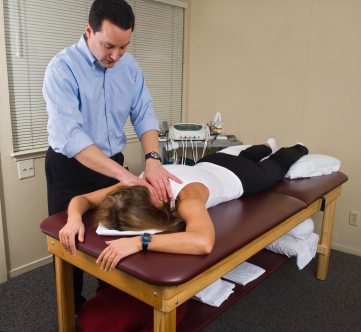
Find a Local Physiotherapist
Physiotherapists often cover specialist areas so it is well worth checking that they cover RSI as a specialism (RSI is also known as WRULD – Work Related Upper Limb Disorder).
Why your Physiotherapist might also use Ultrasound or Acupuncture
Ultrasound breaks up scar tissue and adhesions, reduces inflammation, swelling, calcium deposits and creates a deep heat to a localized area which eases muscle spasms. Adhesions, inflammation, calcium deposits and muscle spasms are frequently the issues faced by the RSI sufferer.
Ultrasound works up to 2 inches deep which is far further than hot packs can achieve. This activity encourages healing by increasing blood flow.
Acupuncture is based on ancient Chinese medicine which believed that the body takes care of itself when negative (Ying) and positive (Yang) forces are in balance. Acupuncture, applying fine needles in the outer layer of the skin, stimulates the flow of energy (called Qi and pronounced Chee) along channels within the body (called meridians).
It is known that it triggers endorphins and some of the bodies natural chemicals that promote relaxation and sleep. Long term muscle pain caused by RSI involves placing the needle into the affected muscle area to create specific relaxation. Laser acupuncture may also be used where a laser is used instead of needles.
Some potential exercises (but you must get advice first)
Stiff Hips : usually caused by sitting too long
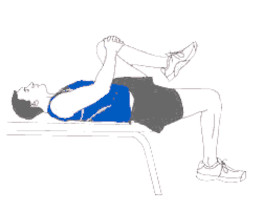
The Thomas Test determines whether your hip flexors are tight. Lay on a bed or table as below and pull each knee up up to your chest in turn. You should be able to get your knee up to your chest – if you can’t and it hurts, this is usually a sign of tight hip flexors.
NHS Scotland have some very helpful hip exercise videos (opens in new tab)